Author Archives: admin

Question to Tories about Botley Petrol Station

I think the loss of the last local petrol stations is an environmental sustainability issue for Planning Policy.Today we learned that the Esso station in Oxpens Rd is to close 17 August. http://www.oxfordmail.co.uk/news/13502318.Oxford_petrol_station_set_to_close_ahead_of_redevelopment/?ref=mr&lp=2

I’m trying to get Vale Tories to recognise that loss of local options for fueling our cars forces thousands of drivers to hit the A34 (already a source of pollution and operating above capacity) to drive further afield to find petrol. I think this is a serious environmental issue that deserves Planning Policy consideration. We have ways to save local pubs, after all.

At the July full Vale Council meeting, I asked the Cabinet member for Planning Policy, Cllr Michael Murray, a question about it.

“The loss of the last petrol station in Botley is an environmental concern when it means thousands of extra cars must travel on the already over-capacity A34 to Peartree, Heyford Hill or Abingdon in order to fill the tank. What policy changes could the Vale consider to address this environmental sustainability issue?”

His reply: “We will all be very aware of the great strides forward in technology that the car manufacturing industry has taken in the past few years. In particular they have focussed on increasing fuel efficiency and reducing emissions. This, coupled with competition between suppliers and increased taxation on fuel to encourage reduced consumption, has resulted in greatly reduced margins and market capacity for roadside retailers. As such we have seen a considerable consolidation of the sector. However the improvement in vehicle range on a tank of fuel has very much reduced the need for local fuel provision. Whilst the BP garage at Seacourt Tower remains open for business, there is no certainty that this, or any other fuel, or other retail, or other commercial use for any building in the Vale, will continue to trade in the long term in the face of changing market conditions, and it does not appear immediately obvious why increasingly scarce council resources should be deployed to developing a fuel retailer policy specifically for Botley as a priority over other more pressing Vale wide matters”.

An unhelpful, and rather snarky response, I thought.

I asked my follow-up question regarding ways in which the council could demonstrate the need for a joined up planning policy approach in Botley, Cllr Murray first remonstrated with the chairman  that my question shouldn’t be allowed as it wasn’t really supplementary to the original question. Chairman ruled against him. So Cllr Murray then stated that views were sought during the consultation on the draft local plan. There would be a further opportunity to submit views/ideas during the Botley supplementary planning document consultation process.


Meeting the Environmental Protection Officers

I asked to meet with two of the Vale’s Environmental Protection officers, to learn about the responsibilites we have at Vale with respect to air pollution and noise pollution. It was ultimately  informative and I am happy I met these two officers, Tim Williams and Paul Holland, who work so hard to make a difference, when in many ways their hands are tied.

Air Pollution

There are only two areas in the Vale where levels of NO2 sometimes exceed the EU threshholds: Marcham and Botley. Abingdon used to be probematic, but since the introduction of the one way streets in the town centre, pollution levels have remained below threshhold. Particulates used to be monitored, but there were never readings anywhere in Vale that were above threshholds, so they aren’t tracked anymore.

So Cllr Catherine Webber, councillor for Marcham, and I, councillor for Botley, met up with the Vale team to find out what Vale does about it.

Vale are required to monitor air quality and to report regularly to DEFRA. Their methods and reports are on the Vale website, here: http://www.whitehorsedc.gov.uk/services-and-advice/environment/pollution/air-quality/how-we-monitor

If an area is designated as an Air Quality Management Area, Vale are required to create an action plan to improve air quality in the area. But they aren’t responsible for seeing that the action plan is carried out. Sadly, this is an area of un-joined-up thinking. There IS no body, apparently, that IS responsible for implementing the action plan. There are realistic obstacles: most often the action needs to be taken by another body, such as county, or highways agency. Action Plans are published after public consultations. A draft of the latest action plan is here: http://www.whitehorsedc.gov.uk/services-and-advice/environment/pollution/air-quality

And finally, the Enviornmental Protection team are consultees on planning applications. They assess the risks to air quality of the proposed development, and the potential effects upon eventual inhabitants, and recommend mitigation when appropriate. They are dissappointed when decisions are taken that ignore the air quality recommendations.

 Noise Pollution

This is a less mature area than air pollution. Although there are many studies coming forward now about how noise pollution affects health and mortality, guidelines publised by DEFRA are basically used to respond to complaints about noisy neighbours.

Vale protocols for including noise in the list of material considerations when determining aplanning application seem to be limited to what noise may be produced by the development or during its construction. It’s not clear that there are any policies in place to consider the effects of environmental noise on the eventual tenants of new homes, offices, or other developments. for example, why would we build new residences right up next to the NOISY A34? See the website: http://www.whitehorsedc.gov.uk/services-and-advice/planning-and-building/find-an-application/comment-on-a-planning-application/material-planning-considerations. I need to inquire further

However, the Environmental Protection team are consulted on planning applications where noise might be an issue. They can recommend mitigation for expected noise levels related to a proposed development, such as triple glazed non-opening windows on sides facing noise, or placing balconies and gardens on the side away from the noise. (I look at the balconies on the new flats at the corner of Arthray Rd and Westminster Way and shake my head. How was that allowed to happen? A second floor balcony in a new building in the AQMA driectly overlooking the A34.)

New guidelines on noise pollution are vague when compared to old guidelines. It used to be, for example, that 50db was the limit for noise levels in a garden, but now guidelines say something vague like ‘significant observed adverse effect’. What is ‘significant’ is somewhat arbitrary, and a sourse of disagreement. Government policies and guidance are here: http://planningguidance.planningportal.gov.uk/blog/guidance/noise/noise-guidance/

I see those handy noise measurement gizmos cost less than £20 on amazon. I should have one. But it would take me to a whole new level of nerdiness to carry one of those around with me.

There is much work to be done.

Grants for Communities

Vale Grants for Communities

There are a number of grants available from the Vale for community groups and Parish Councils. Below is an outline of what each grant is and what it can be used to pay for. There is a Grants Officer who can help groups decide which fund is most suited to the project you need to fund and can support you through the application process. Some of the application forms are points based and it is important to comply with all of the criteria to stand the best chance of your application being successful. All District Councillors sit on the Area Committees that make the final decisions on some of the funds, so do get in touch with Debby or Emily for information and support with your application.

Grant title Who/what it can fund Deadlines
Festival and Events Grant Up to £1,000 per application (£15,000 available each year) Events run by community groups and charities. Applications are open through the year. Groups need to apply at least 4 weeks before the event is due to take place.
Capital Community Grant Up to £5,000 per application. Match funding of 50% or more must be secured (minimum of £100,000 available each year) Community groups or Parish/Town councils. Must show benefit to communities and demonstrate local need. Previously used for furniture, equipment, IT, building improvements, etc. Two rounds per year, the next one expected in September. Money must be spent one year from award date.
New Homes Bonus £100,000 is available each year subject to Council’s Budget. No limit for individual applications. Community groups or Parish/Town councils that have seen housing growth. Revenue or capital to support the integration of new homes into existing communities. Rolling applications but not open until September

 Other financial support available from other parts of the Vale District Council:

  • Disability Facilities Grant (to fund adaptations for individuals, usually on their own homes)
  • Home Improvement Loans (for elderly people in private housing to pay for renovations on an equity loan basis. The money is recovered by the Vale when the house is sold)
  • Fuel Poverty Grants (available for individuals via the Energy Officer in Corporate Strategy)
  • LEADER funding (£1.5m is available for private businesses. Aims to boost enterprise and the rural economy.)

Information about all of the funding and grants available from the Vale is available at: http://www.whitehorsedc.gov.uk/services-and-advice/community-advice-and-support

Other organisations that could help your group find funding

  • Oxfordshire Community and Voluntary Action provide community groups with details of other funds available in Oxfordshire and support to apply for these ocva.org.uk
  • Oxfordshire Rural Community Council provide advice and capacity building for a wide range of groups and initiatives that support rural areas orcc.org.uk

Being on Planning Committee vs well, not

Someone recently asked me why I wasn’t representing the community by sitting on the Vale Planning Committee. The question revealed a lack of understanding about both the responsibility of a member of Planning Committee, and what it means to represent a community. A councillor cannot represent their community whilst wearing their planning committee member hat.

Responsibilities of a planning committee member:

A member of planning committee is expected to remain open minded on any planning application until the last minute, and to not actively support or oppose an application. Whilst sitting as a member of the planning committee, members are not representing their communities; they are interpreting planning policy and law for each individual application.

Representing my community:

I listen to what members of the community think about an application, and consider whether I can find any policy that supports the community view. (This is usually a view opposed to the application.) If I can find such a policy, then I can actively work to get planning officers to consider our views, try to get applicants to amend their plans to accommodate local concerns, and use my powers of persuasion to lobby planning committee members. This freedom to speak out and actively work to influence decision making is exactly why I didn’t choose to serve on Planning Committee.

So far, in all that I’ve seen in the years since I was first elected, I’ve done a pretty good job at ‘representing my community’ by NOT being on planning committee.


Trapped in Botley

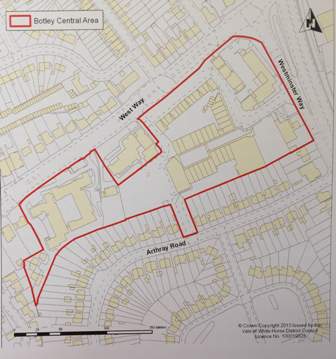
Botley Area Redline smallerI fear Botley is now trapped into a development larger than is needed or wanted.

Doric agreed to pay gazillions for West Way Shopping Centre and the land over by Grant Thornton, the library, Seacourt Hall and Baptist Church. In order to make their purchase financially viable, Doric must build a large development to ensure they make back a suitable profit on their investment.

Here’s what’s happened so far:

  1. Lib Dem Vale administration offers for sale Site 1 of West Way area (corner of West Way and Westminster Way), with a mind to investing some of the profits in updating the West Way Shopping Centre.
  2. Election 2011 brings Tories to power in Vale.
  3. Vale decides to sell Site 1 to Doric (after the top bidder was eliminated).
  4. Doric also wants Site 2, so Vale decides to sell that too, a month later. Doric agrees to pay a gazillion pounds.
  5. In the land sale contract, Vale stipulates some development constraints: supermarket, medical centre, replacement community hall, library and Baptist Church.
  6. Doric begins to consult on a plan to develop Site1 plus Site2 plus the larger area of central Botley (Elms Parade, Vicarage and Field House).
  7. The community gets its first inkling of what’s going on, and erupts in mass objection to the demolition of the heart of Botley to build an eight story block of student accommodation, super store, multiplex cinema and bars and clubs.
  8. Months later (and thousands of hours of hard work by community members) , on 3 Dec 2014, the planning committee unanimously refuses permission.
  9. Doric have until 20 Dec 14 to appeal this refusal, or the contract is terminated. So they appeal.
  10. A few months go by with no progress.
  11. In March 2015, Vale Leader Matthew Barber announces that Doric are willing to withdraw their appeal in exchange for an extension of the planning approval deadline by a year or more. He is minded to accept the offer, to give Doric a second crack at the whip. There is no opportunity for the community of Botley to object or offer another solution.
  12. Basically, Doric says, “We will save you the expense of defending council’s decision to refuse permission, if you will give us another year or so to meet a less stringent requirement.”
  13. So now Mace, who bought half of Doric, are planning another application. Mace say it is a smaller footprint, excluding Elms Parade, the Vicarage and Field House. But the sales price has not changed: it is still a gazillion pounds. Only now Mace have to make a much smaller space just as economically viable. “How will they do that?”, is a fair question.
  14. How can this possibly work out for the benefit of the people of Botley? We are trapped in a deal to sell the centre of Botley for a price that will require a huge development in order for Doric/Mace to make back their investment.

In a perfect world, the Vale Leader would have consulted with the community back in 2011-12 before he decided to sell to Doric for regeneration, and then ensured the subsequent proposal upheld Botley’s status as a local service centre. Or, he could have played by the rules of the game that he defined in the first place, and cancelled the contract when Doric failed to get planning approval. #FairPlay

I think this:

  • Doric offered to withdraw their appeal because they knew that had only a very small chance of winning it.
  • Vale Leader accepted Doric’s offer because he didn’t want to defend their planning decision. #WinWin
  • There was the cost of defending against the appeal (we’re always hearing from the planning committee members about the cost of appeal).
  • And there was the desire for the capital receipt from the sale.
  • After all, it was always a conflict of interest. Cabinet and Senior Vale officers are in favour of this development; it wasn’t likely they’d decide to defend the planning decision to refuse it.

Had Matthew Barber taken his opportunity to end the Doric Deal when planning permission was refused, he could have opened the bidding to developers who wanted to work with the community to improve the face of West Way to provide the local services and shops that Botley needs and deserves. But probably the sale price would have been half a gazillion, so less profit.

So, are we are trapped into a behemoth of a development plan, driven by developer greed and Vale profit? I hope not. I do so want to be wrong.


Planning Policy for Botley – 3 things

A Development Brief for Botley. Vale started work on this in April 2015 (through a consultant, BDP). Years ago, Doric and Vale said they’d do one, but it never happened. A Development Brief would inform future Botley development by capturing community views of what’s needed and what matters. Vale decided in late June 2015 (don’t know why) to instead create a…

Supplementary Planning Document for central Botley. This document, once adopted, becomes a proper planning policy, containing the long term vision of what Botley needs. The area is wider than the Doric application covered; the term is longer than just the next few years. This process involves a public consultation and feedback before the final SPD is approved by Cabinet. Once adopted, this SPD will have weight for planning decisions in this area. Consultation is expected between the end of July and the first week in September 2015. There was some question about how the work on this SPD would sit alongside the ongoing work on the…

Neighbourhood Plan for North Hinksey, which includes the Botley Central area (but not any areas of Cumnor Parish). This situation, with the NP progressing simultaneously with the SPD, is unique. It’s a valid question to ask how each will influence the other.

The SPD will be completed first, a continuation of the work on the nearly-completed Development Brief, with adoption expected in autumn 2015. That is just ahead of when we expect the Mace planning application to be submitted, in which case the SPD would have weight in determining the Mace application.

An SPD is always linked to the currently adopted Local Plan, so this SPD will be created roughly in accordance with the saved policies of Local Plan 2011. When the new Local Plan 2031 is adopted, the SPD will have to be revisited to ensure it is in accordance with the new Local Plan.

Here’s the hierarchy of planning policies:

  1. National Planning Policy Framework (NPPF) and National Policy Guidance
  2. Adopted Local Plan (currently the saved policies from LP-2011)
  3. Adopted Neighbourhood Plan
  4. Supplementary Planning Documents

The Neighbourhood Plan should be developed to be roughly in accordance with the NPPF and the currently adopted Local Plan. If it’s discovered there’s a conflict between the NP and the adopted SPD, or the adopted Local Plan, then the NP will be re-visited with expert help from Vale planning officers.

All this leads me to conclude that the most important thing at the moment is the SPD, because it’s likely to adopted first out of all the policy docs. The community’s contribution to this SPD is both important and urgent; consultation is expected to begin the last week of July, and the policy will be in force for years.

County Consultation on bus services and Dial a Ride

Here’s a letter I had from the County about this consultation. ~ Debby


Dear Oxfordshire District Councillor,

RE: Subsidised buses and Dial-a-Ride – public consultation

I am writing to tell you about a public consultation being held over the next 12 weeks about a possible change to the subsidised bus and Dial-A-Ride services in Oxfordshire.

The council would like to get your views so that we can fully understand all opinions and potential impacts of any proposed change. Further details about our proposals and an opportunity to respond can be found at: www.oxfordshire.gov.uk/stconsultation

As an District Councillors, we would also be grateful if you took the time to pass this information on to any of your constituents who you think may be effected or in any way interested in feeding back into our consultation process.

Why is the council making savings?

On-going cuts in central government funding mean Oxfordshire County Council has to make savings. The council is currently in the process of making approximately £290 million of savings. Those savings began in 2010 and run until 2018. On top of those savings, the council currently believes it may need to save a further £60 million.

Supported transport savings

As part of the council’s budget setting process in February 2015, councillors reduced the overall supported transport budget by a fifth (£6.3 million). As far as possible, we are trying to make these savings in supported transport by running services more efficiently.  We have identified that we can achieve nearly £3.7 million in savings by bringing together all the supported transport services we operate and fund.  However, this is not enough.  The council needs to find a minimum of £2.6 million in additional savings and this means looking at supported transport services which the council is not required to provide by law.  This will inevitably impact some people in the county.

Have your say on our proposals

Please visit www.oxfordshire.gov.uk/stconsultation and let us know what you think of our proposal for the Dial a Ride service, and our proposals in relation to subsidised bus services including:

Subsidised buses – Withdrawing bus subsidies altogether

Subsidised buses – Reducing funding to subsidised bus services – and adopting the principle of prioritising, where possible, services most likely to be used by the elderly and disabled

Dial-a-Ride – Ending direct funding of the Dial-a-Ride service – encouraging community transport groups across the county to deliver a replacement service.

You can read a copy of the consultation document online at www.oxfordshire.gov.uk/stconsultation or pick up a copy at an Oxfordshire County Council library.

We are also organising five ‘Subsidised Bus and Dial-a-Ride public consultation’ events at venues across Oxfordshire to explain our proposals and to get feedback. Meetings are open to everyone and are being held on:

  • Mon 6 July in Banbury Town Hall, Banbury – 10.30am-12.00pm
  • Mon 6 July in Didcot Civic Hall, Didcot – 16.00pm-17.30pm
  • Tues 7 July in Witney Methodist Church, Witney – 10.30am-12.00pm
  • Weds 8 July in Abingdon Guildhall, Abingdon – 16.00pm-17.30pm
  • Weds 8 July in OCC County Hall, Oxford – 19.00pm-20.30pm

Oxfordshire County Council have asked that the Oxfordshire Rural Community Council (ORCC), a not for profit, community development organisation are the independent facilitator during the consultation. If you need support in commenting on the county council’s proposals or are interested in attending one of our events, please get in touch with the Oxfordshire Rural Community Council on 01865 883488 or email orcc@oxonrcc.org.uk.

Thank you for taking the time to read this message and please don’t hesitate to contact my team at Supported.Transport@Oxfordshire.gov.uk if you have any further queries.

Yours sincerely,

Cllr David Nimmo Smith

How to make a planning application decision

Only properly trained councillors may serve or substitute on the Planning Committee. So we’ve been undergoing the required training.

Here are the policy priorities for deciding whether planning permission should be granted or refused.

  1. NPPF. (National Planning Policy Framework) This has a bias in favour of sustainable development. In the current situation where Vale doesn’t have a 5 year supply of housing land identified, basically every location is sustainable unless it’s the middle of nowhere. Vale tends to focus heavily on ease of access to transport and shops. I’ve not heard any attention paid to environmental sustainability, and Vale continues to build houses in areas with poor air quality. (I’m not clear if all of the official Planning Guidance docs issued by government are considered part of NPPF, for this purpose. I suppose they are.)
  2. Local Plan. Right now, we do not have an in-force local plan. We only have some saved policies from Local Plan 2011 – this is our OLD Local Plan. The saved policies have all been determined to be in accordance with NPPF. These saved policies are currently our only local plan policies.
  3. Neighbourhood Plan. A few communities have an adopted Neighbourhood Plan. A few more have begun the process of creating a neighbourhood Plan. You can see about it on the Vale website, although the information is out of date. http://www.whitehorsedc.gov.uk/services-and-advice/planning-and-building/planning-policy/neighbourhood-plans
  4. SPD. (Supplementary Planning Document). This Vale webpage explains what SPDs are, but the info is out of date. http://www.whitehorsedc.gov.uk/services-and-advice/planning-and-building/planning-policy/local-development-framework/supplementary-


Planning Enforcement is YOUR Job

And my job. It’s everyone’s job.

When a planning application is approved, it has conditions attached. Sometimes these conditions are that plans must be approved before a certain action can be taken, such as, ‘all car parking must be in place prior to occupancy of the first flat’, or that new materials must match existing. Sometimes it’s a lifelong constraint, such as ‘this annexe may not be used as a separate dwelling place’, or ‘this hedge/tree must be preserved and maintained’.

The Vale Planning Enforcement team does not proactively track conditions to ensure that they are being upheld. I understand that they USED to, but with budget cuts many years ago, this service was stopped. These days, Vale relies on the public to report planning enforcement issues. I don’t think very many people or parish councils know that. I didn’t know it until last year.

Planning Enforcement is one of the most requested services from the Vale. Unfortunately, people usually wait a long time before finally contacting Planning Enforcement, and do it as a last resort, when remedy is often more difficult.

I have an idea that I’m discussing with each of the local parish councils. (You can read about it; it’s item 4 in the District Councillor Report for June 2015, on my blog.) Parishes and residents could track the conditions of each approved planning application, and contact the Planning Enforcement team directly when something goes wrong. It’s fairly straightforward to capture the info; the published decision notice includes all the conditions. We could list those on a parish website, and keep it up to date by periodic review. After the development was complete, only the longer term conditions would remain. This could be an accessible source of community knowledge and awareness, and serve as a foundation for a community scheme for residents to become the eyes and ears of planning enforcement.

My offer is to help set this up in each parish that’s interested. What do you think?